.png)
Midwives for Human Rights!
That may sound like a small drafting detail. It is so much more.
This year the Human Rights Council published an important update to its technical guidance on applying a human-rights based approach to eliminating preventable maternal mortality and morbidity (A/HRC/60/43). That document — adopted as part of the Council’s 60th session — now explicitly calls for multi-stakeholder consultations that include health workers “including midwives” and encourages States to implement the updated guidance (OHCHR). Yet until now midwives rarely featured by name in this maternal health human-rights text that should logically include them. The omission was, quite simply, absurd given the weight of the evidence.
For decades the evidence has been unequivocal: midwives, when educated and supported to the international standards, can provide the vast majority (over 90%) of essential sexual, reproductive, maternal, newborn and adolescent health services (World Health Organization). WHO, UNFPA, and ICM reports show that scaling midwifery can avert a huge number of maternal, neonatal deaths and stillbirths... up to two-thirds!
Universal access to midwives can avert 67% of maternal deaths, 64% of newborn deaths, and 65% of stillbirths by 2035. Even a modest 10% increase saves 1.3 million lives every year. (The Midwifery Accelerator)
With evidence so clear on the significant impact of midwives… it is almost absurd that this resolution or its technical guidance did not mention this as a critical part of the solution.
Midwives are not only clinical providers — they are guardians of human rights in practice. Midwifery models of care prioritise respect for bodily autonomy, informed consent, continuity of care, dignity, and culturally acceptable services. Those are exactly the human-rights principles the Council’s guidance promotes (e.g. informed consent, privacy, non-discrimination, and accountability).
Making midwifery visible in the guidance is therefore more than an occupational recognition: it anchors a proven model of person-centred care within a human-rights framework and makes it harder for policy and funding decisions to ignore the workforce that protects women’s rights in pregnancy and childbirth (OHCHR).
This victory was earned the hard way — by partnering, convening evidence, and sustaining political engagement. We worked side-by-side with governments, professional associations, women’s human-rights organisations and UN partners over the last year to ensure that midwives and woman-centred care are reflected in the resolution and guidance.
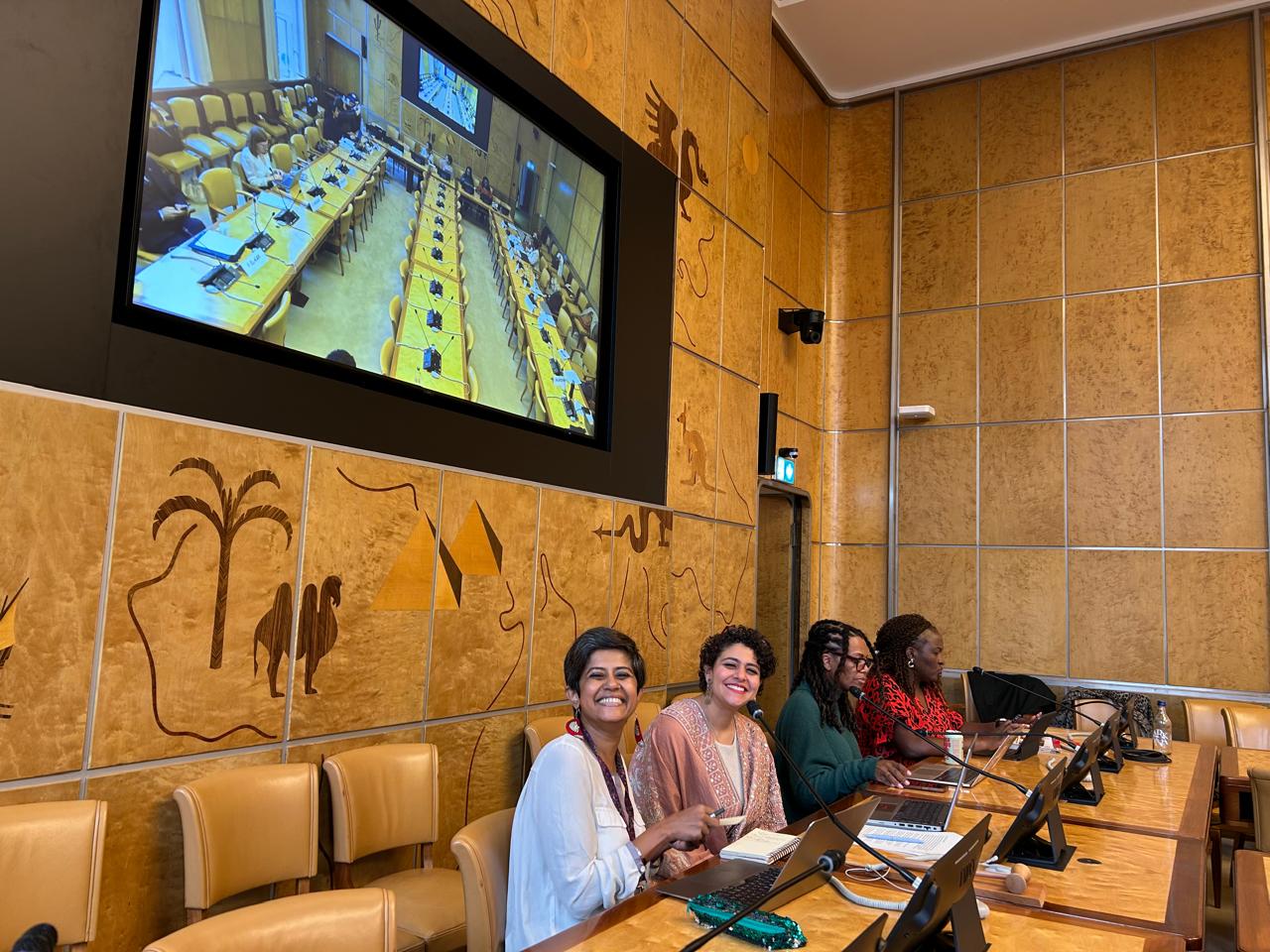
Together with our partners, we worked on four activations. In February, we submitted recommendations to the update of the technical guidance. In April, we joined an expert consultation in Geneva to discuss the technical guidance and provide recommendations outlining the need for woman-centred midwifery models of care. In June, we joined a Human Rights Council side-event sharing a panel with experts from Center for Reproductive Rights, WHO and UNFPA. We highly commend the leadership of delegates from New Zealand, Estonia, and Colombia for leading a resolution at the Human Rights Council this September on preventable maternal morbidity and mortality, and advocating for midwives as a key solution. Finally, ahead of the Human Rights Council meeting in September, we contributed to a special briefing for Member States and the human rights council delegates to ensure they have a clear understanding on who midwives are and what they do along with the benefits of the midwifery models of care. We are proud to have worked with PUSH champions at the Center for Reproductive Rights, IPPF, Sexual Rights Initiative, Women Deliver, WHO and UNFPA on this briefing.
Those activities translated robust clinical and rights-based evidence into language that negotiators could adopt — language that now appears in the Council’s updated technical guidance.
Inclusion in the guidance is a necessary step — not the finish line. Saying “midwives” in a prominent human-rights instrument changes the frame: it helps mobilise resources, demand regulation and quality standards, and hold states accountable to the rights of women and gender diverse people.
As geopolitical instability deepens, climate shocks intensify, and health and economic inequalities widen, governments face difficult trade-offs. Yet amid competing priorities, one high-impact, cross-sector investment stands out for its unmatched return: midwives. Evidence shows that fully integrating midwives and woman-centered midwifery models of care doesn't only progress human rights, it accelerates economic, social, gender, and environmental indicators. Midwives unlock growth, strengthen resilience, and accelerate progress on the Sustainable Development Goals—while saving millions of lives.
Member States, UN agencies and donors must act: implement the recommendations, invest in midwifery education and regulation, and ensure midwives can work in enabling, rights-respecting environments.
We will keep pushing — convening partners, supporting national consultations, and tracking implementation — because when midwives are visible, human rights for women and birthing people stand a far better chance of becoming real (OHCHR).
.png)


