.png)
Launching the Feminist Health Systems Charter and Call to Action at Women Deliver 2026
At the closing ceremony of Women Deliver 2026, advocates, researchers, health workers, youth leaders, and global health partners came together to celebrate the launch the Feminist Health Systems Charter and Call to Action — a bold new framework calling for health systems grounded in human rights, gender justice, dignity, and public accountability.
“Health is our leverage for justice. States are legally obligated to respect, protect, and fulfil everyone's right to the highest attainable standard of health. This is non-negotiable." ~ Merette Khalil, PUSH Campaign Lead mentioned at the closing ceremony
.jpeg)
This is the crux of the Charter for Feminist Health Systems; this advocacy tool translates states' existing human rights obligations into concrete principles for redesigning health systems around dignity, equity, and care.
“Midwives are the most feminist health professionals, as reflected by the midwifery philosophy and model of care, we cannot build feminist health systems without closing the one million midwife gap"
The timing is critical. As the world marks International Day of the Midwife, a stark reality persists we are missing one million midwives globally. This shortage isn't merely a staffing gap—it represents a fundamental flaw in how health systems prioritize and value the care work that predominantly women perform. The charter seeks to address this systemic undervaluing of those providing and seeking care.
The Launch of the Feminist Health Systems Charter was hosted by Women Deliver, the PUSH Campaign hosted by the International Confederation of Midwives, Columbia University Mailman School of Public Health’s Heilbrunn Department of Population and Family Health, and the Health Systems Global Thematic Working Group on Gender and Health Systems and marked a significant moment.
Presented by Kinza Hassan from Women Deliver, the charter outlines twelve comprehensive principles grounded in international human rights law. These include the right to health, intersectionality and structural determinants, anti-colonialism and decoloniality, person-centred care across the course, sexual and reproductive health and rights, disability justice, mental health, conflict and humanitarian emergencies, refugees and migration, climate and environmental justice, health workforce, and universal health coverage.
The Charter emerges at a time of deep global inequity and mounting backlash against gender equality and bodily autonomy. Across the world, women make up the majority of the health workforce and are the primary users of health services, yet health systems continue to reflect and reinforce patriarchal, colonial, racist, ableist, and neoliberal power structures that exclude and marginalize communities.
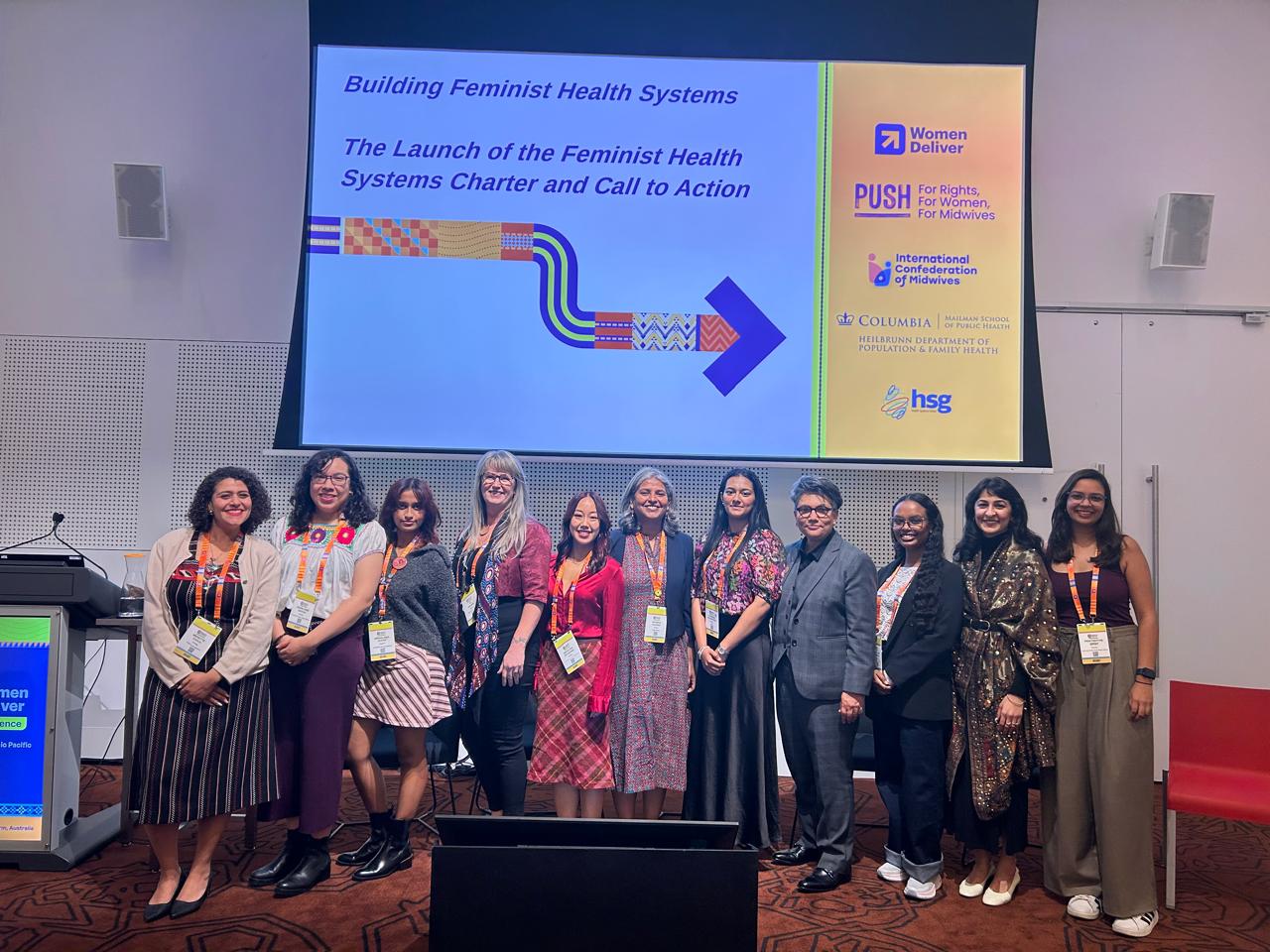
The launch of the Charter opened by situating the Charter within the broader political and economic realities shaping health systems today — from austerity and privatization to shrinking civic space and attacks on sexual and reproductive health and rights. Speakers emphasized that health systems are not neutral: they are shaped by power, and too often fail to uphold dignity, autonomy, and justice.
Maliha Khan, the President and CEO of Women Deliver, highlighted how this Charter is operationalizes the newly launched Melbourne Declaration which calls for a revisioning of the international development sector around the principles of state and public accountability, collective voice and social justice, solidarity and dismantling systems of oppression, local priorities and accountability to the people, antimilitarism, and economic justice.
The Feminist Health Systems Charter and Call to Action responds to these failures by articulating a vision for rights-based, people-centered health systems that prioritize equity, participation, accountability, and community leadership. More than a statement of principles, the Charter serves as a practical advocacy and accountability tool for governments, multilateral organizations, civil society, health workers, and communities working to advance structural transformation.
A powerful storytelling panel brought these realities to life through lived experiences from across movements and contexts. Speakers highlighted the urgent need for feminist health systems that respond to the realities of those most excluded from care and decision-making:
"Maternity care is a fulcrum what the system claims to value and what actually happens is most visible and most consequential. For example, we need to embed genuine informed consent, not just a signed document. Moreso, midwives are reprimanded for supporting women. Continuity of care, relationship-based midwifery care or doula care should be standard, non-exception. When families know their provider, outcomes improve, interventions decrease, and trust grows. For women navigating socially complex circumstances, midwives are often the difference between empowerment and trauma."
“Health systems do not fail women by accident. Health systems are failing us by design. They have never been designed around people's lives, rights or realities "
“For most of medical history, researchers studied men because women's bodies were considered too complicated, too variable to be clean research subjects. Then these findings were applied to women anyway. The result? Women endure over ten years of pain before endometriosis diagnoses, and systematic health disparities that remain invisible in aggregate data, limiting evidence-based implementation and policies.”
"We recognize health as a fundamental human right, which must be delivered through interprofessional approaches, comprehensive sexual and reproductive health and rights, and confronting colonialism and racism”.
Together, the panelists demonstrated that feminist health systems are not abstract ideals — they already exist in the practices, movements, and community-led alternatives being built around the world.
As the session concluded, participants were invited to see the Charter not simply as a document, but as a living call to action — one that demands collective accountability and sustained advocacy to reimagine health systems that truly serve all people, especially those most often left behind.
The Charter for Feminist Health Systems is now available for endorsement and implementation, offering midwives and their allies a powerful tool to advocate for the systemic changes their profession and the women they serve have long deserved.
.png)


